
Your child falls during a sprint to first base, takes an elbow going up for a rebound, or gets clipped by a stray helmet on the sideline. None of it looks dramatic in the moment, but a single hard hit to the mouth is enough to chip a tooth, split a lip, or knock something out entirely. If you have an active kid, this kind of dental emergency is closer to inevitable than most parents realize.
That is exactly why mouthguards for kids matter so much, and why we build them into nearly every conversation we have with sports families. A properly fitted mouthguard does more than ride along in a gym bag. It absorbs force the moment it counts, protects teeth that are still developing, and can spare your child years of restorative dental work later on.
We bring a perspective to this that most practices cannot with Dr. Rich Clark, having spent years as a youth swim coach before he ever picked up a dental handpiece, guiding kids ages five through eighteen. That background gave him a close-up view of how physical activity, confidence, and oral health interact in young athletes. It still shapes how we talk to families here in Newtown Square about protecting a child’s smile before an injury happens, not after.
In this guide, we will walk you through how mouthguards for kids actually work, the different types available, when your child needs one, and what separates a custom mouthguard from anything you can grab off a store shelf, all as part of the pediatric dentistry we practice every day.
What Is a Mouthguard and What Does It Actually Do?
A mouthguard is a soft, flexible appliance worn over the teeth, and its operation comes down to basic physics rather than anything complicated.
When something strikes your child’s face, whether it is a stray elbow, a fastball, or a fall on the blacktop, that force has to go somewhere. Without a mouthguard, the teeth, gums, and jaw take the impact directly. With one in place, the guard cushions the blow, spreading that force across a wider surface and creating a buffer between the teeth and whatever they collide with.
That single mechanism protects several areas at once: the teeth, the soft tissue of the lips and cheeks, the gums, and the jaw joint. Some research even links mouthguard use to a lower risk of concussion, since a well-fitted guard can reduce the impact that travels through the jaw.
Children face more risk here than adults do, and for a few reasons that tend to compound on one another. Their teeth are still developing, their bones are softer, and their movements on the field or court are less controlled, so a child chasing down a soccer ball is far less likely to brace for contact the way an adult instinctively would.
It helps to think of a mouthguard as serving three roles rather than one: protection, prevention, and treatment support. It protects healthy teeth before an injury occurs, prevents a condition like grinding-related wear from worsening, and, in some cases, supports treatment already underway, such as the use of guarding braces during orthodontic care. Most parents focus on that first role, but the other two matter just as much, and all three tie back to the preventive care we build into every visit, whether your child is in for a routine checkup or coming in specifically for a mouthguard fitting.
The 3 Types of Mouthguards for Kids
Not every mouthguard does the same job, so it helps to think in terms of three categories rather than treating “mouthguard” as one single product.
1. Sports Mouthguards
If your child loves playing any contact or collision sport, a sports mouthguard is non-negotiable. That covers the sports you would expect, like football, hockey, lacrosse, and wrestling, along with several that catch parents off guard, including basketball, soccer, baseball, and gymnastics.
Football mouthguards for kids deserve their own mention here because a football helmet, for all the protection it offers, does nothing for the teeth and jaw. The helmet protects the skull. The mouthguard protects everything inside the mouth. One does not substitute for the other, and a child wearing a helmet without a mouthguard is still exposed to some of the most common dental injuries on the field.
A well-fitted sports mouthguard helps prevent tooth fractures, knocked-out teeth, cut lips and cheeks, and jaw injuries, and that protection holds up across far more sports than most families assume, water polo and lacrosse included. We have seen the value of that protection firsthand, from the pool deck to the dental chair, which is part of why we push for it across every sport a child plays, not just the obvious ones.
2. Night Guards for Bruxism
The clinical term “bruxism” refers to grinding or clenching the teeth during sleep, and it shows up in children far more often than most parents expect. Your child does not need to play a single sport to need a mouthguard. Grinding at night is reason enough.
You can usually spot the signs without a dental exam. Flattened or worn tooth surfaces, morning jaw soreness, recurring headaches, and restless or disrupted sleep are the clearest indicators, and some children grind loudly enough that you can hear it from another room.
A night guard works on the same underlying principle as a sports mouthguard, just in a different setting. The upper and lower teeth form a barrier, absorbing grinding pressure rather than allowing the enamel to take the wear. Left untreated, that wear adds up, since enamel cannot regenerate once it is gone, and bruxism can eventually lead to jaw joint problems and tooth sensitivity if nothing interrupts the pattern. Store-bought night guards exist, but a custom-fitted option tends to hold up better for a sleeping child, since a guard that shifts or falls out overnight offers no protection at all.
3. Orthodontic Mouthguards
If your child currently wears braces or another orthodontic appliance, sports carry a different kind of risk. Brackets and wires that sit close to the soft tissues of the mouth can cause cuts or lacerations on impact, in addition to the usual risks to the teeth and jaw.
A custom orthodontic mouthguard is built to fit around that appliance rather than against bare teeth, so it protects the soft tissue from the hardware itself while also guarding months of orthodontic progress against a single bad hit. Skipping a mouthguard during active orthodontic treatment puts both the teeth and the treatment timeline at risk, a tradeoff most families would rather avoid altogether.
How Mouthguards Prevent Long-Term Dental Damage
Tooth enamel does not grow back. Once it chips, cracks, or wears away, the only way to restore it is through dental treatment, and that is exactly why prevention carries more weight for children than it does for adults.
The American Academy of Pediatric Dentistry has long recommended mouthguards for children and youth in organized sports, and the research supports that guidance. Studies on youth sports injuries consistently show that the upper front teeth absorb the brunt of dental trauma. A peer-reviewed study published in the journal Dental Traumatology, which reviewed tens of millions of high school athletic exposures over fifteen years, found that most athletes who suffered a dental injury were not wearing a mouthguard at the time, with injuries happening substantially more often during competition than during practice.
That gap between practice and competition matters because it shows compliance tends to break down right when the risk is highest. A single sports injury, like a knocked-out front tooth, can turn into the kind of dental emergency that sets off years of restorative treatment: root canals, crowns, space maintainers, and in some cases implants once your child reaches adulthood. Prevention, by comparison, almost always asks less of your time, your child’s comfort, and your wallet.
That same logic carries through to bruxism. Left unaddressed, grinding does not stay at a single level of severity. It tends to progress, wearing enamel down a little more each year, until your child is dealing with sensitivity, jaw pain, or visible damage that a properly fitted night guard could have prevented years earlier. If you want a broader primer on what to watch for between visits, our guide to dental basics covers the fundamentals every parent should know, and a custom mouthguard fits squarely into that same preventive mindset.
We also offer flexible membership and payment plans that make a step like this easier to budget for, since a custom mouthguard is a small, one-time investment next to the cost, time, and worry involved in treating a fractured or knocked-out tooth.
Custom Mouthguards vs. Store-Bought: What You Need to Know
Nearly every sporting goods store will have a wall of mouthguards, but they all fall into one of three categories: stock, boil-and-bite, or custom-fitted.
1. Stock mouthguards come in a few preset sizes with no real adjustment possible.
2. Boil-and-bite mouthguards soften in hot water and mold somewhat to your child’s teeth once bitten down on, which is an improvement, though still a rough one.
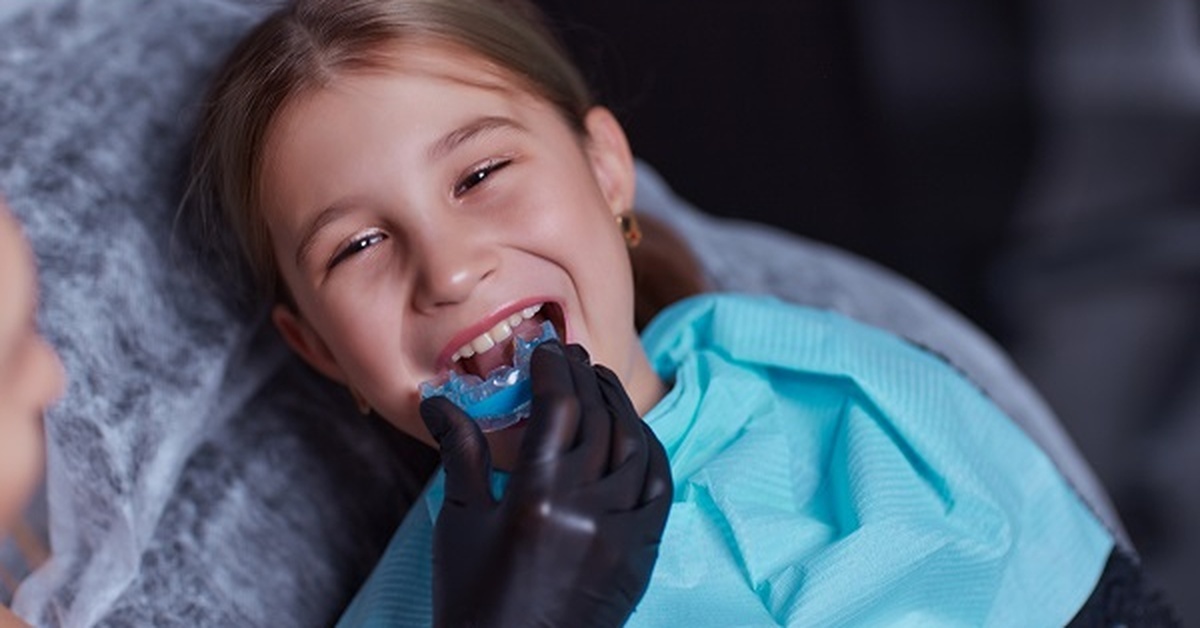
3. Custom mouthguards for children are built from an actual impression or a digital scan of your child’s mouth, so the fit matches the unique shape of their teeth and bite rather than an approximation.
For an active kid, that difference shows up fast. A loose or bulky mouthguard is uncomfortable, makes it hard to breathe or talk, and tends to be the first thing pulled out the moment a coach looks away. A mouthguard your child will not keep in provides no protection at all, no matter how well it was designed on paper, which is exactly why comfort drives compliance more than any other single factor.
Getting a custom mouthguard starts with a simple impression or digital scan of your child’s teeth. From there, a lab fabricates the guard to the exact contours of their mouth, and we check the fit, bite alignment, and comfort before your child leaves, adjusting anything that needs it on the spot.
Because children are still growing, a custom mouthguard will not last forever. Most kids need a new one every season or two, sooner if they lose or gain teeth or start orthodontic treatment. The best mouthguard for kids is simply the one built specifically for them, not the one that happens to be on the shelf at the store.
When Should Your Child Start Wearing a Mouthguard?
There is no single age that applies across the board here. Activity level and stage of tooth development matter far more than a birthday does.
As a general rule, your child should start using a mouthguard as soon as they begin any organized sport involving contact, collisions, or fast-moving equipment, even at the recreational level. That holds whether they still have a full set of baby teeth, a mix of baby and permanent teeth, or a fully permanent set, though the fit and type of guard may need to change as new teeth come in.
If your child shows signs of bruxism, start the night guard conversation as soon as those signs appear, regardless of age, since there is no real benefit to waiting, and earlier treatment generally means less enamel wear by the time it gets addressed.
The same applies to orthodontic treatment. Your child should have a mouthguard ready from the first day their braces go on if they play any sport with a risk of contact, rather than waiting until the first injury makes the need obvious. If you are not sure where your child falls on any of this, their first visit with us is a natural place to start that conversation.
Mouthguards and Children With Special Needs
For a child with sensory sensitivities, the idea of wearing a mouthguard can feel overwhelming before it ever touches their teeth. Texture, pressure, and the sensation of something foreign in the mouth can trigger resistance that has nothing to do with willingness and everything to do with how your child’s nervous system processes the experience.
We work directly with families on this, and a custom fit matters even more here, since an ill-fitting guard amplifies the exact sensations that make a child want to take it back out. We often take a gradual approach instead, introducing the mouthguard in short, low-pressure sessions at home or in the office before ever expecting your child to wear it through a full practice or game.
That approach carries through to everything we do in our special needs dentistry services, where every appointment starts with your child’s individual comfort rather than a one-size-fits-all process.
What to Expect When Getting a Custom Mouthguard
Getting a custom mouthguard with us is a short, low-stress appointment, not a separate ordeal layered on top of an already busy schedule.
The visit starts with a simple impression or digital scan of your child’s teeth. From there, we send it off to be fabricated to the exact shape of their mouth and let you know the expected turnaround before you leave. Once it is ready, your child comes back for a quick fit check, where we review the bite, comfort, and overall fit before sending them back out onto the field, court, or pool deck with one less thing to worry about.
We see families from Newtown Square, Broomall, Media, Wayne, and across Delaware County and the Main Line for exactly this kind of appointment, and most parents are surprised by how quick and straightforward the process is once they get started.
Ready to Protect Your Child’s Smile With Mighty Bites?
Every child playing a contact sport and every child showing signs of nighttime grinding deserves the protection a properly fitted mouthguard provides. Custom mouthguards for children are built specifically for your child’s mouth and stage of development, not guessed at off a shelf.
Book an appointment today and give your child’s smile the protection it needs for whatever sport, season, or stage comes next. We proudly serve families throughout Newtown Square, Broomall, Delaware County, and the Main Line.
Frequently Asked Questions
What is the best mouthguard for kids who play football?
The best mouthguard for kids who play football is a custom-fitted mouthguard made by a pediatric dentist. Custom guards offer a tighter fit than boil-and-bite or stock options, which matters in a high-contact sport where the mouthguard needs to stay in place through every play.
At what age should a child start wearing a mouthguard for sports?
Your child should start wearing a mouthguard as soon as they begin any sport involving contact or fast-moving equipment, regardless of their exact age. Activity level matters more than a specific birthday.
How is a custom mouthguard different from a boil-and-bite mouthguard?
A custom mouthguard is made from an impression or digital scan of your child’s teeth, so it matches their exact bite and tooth shape. A boil-and-bite mouthguard is a generic shape that is softened in hot water and then bitten into, which offers a looser, less secure fit.
Can my child wear a mouthguard with braces?
Yes, and we recommend it. A custom orthodontic mouthguard is designed to fit around brackets and wires, protecting both the soft tissue of the mouth and the progress of the orthodontic treatment.
How do I know if my child is grinding their teeth at night?
Common signs of nighttime teeth grinding, known as bruxism, include flattened or worn tooth surfaces, morning jaw soreness, recurring headaches, and restless sleep. Some parents notice the grinding sound directly.
How often does a child’s mouthguard need to be replaced?
Most children need a new mouthguard every season or two as their teeth develop and shift. A mouthguard should be replaced sooner if it no longer fits snugly or if your child loses or gains teeth.
Are mouthguards covered by dental insurance?
Coverage varies by plan and provider, so it is worth checking directly with your insurance carrier or asking us at your child’s appointment. We accept most major private dental insurance plans and can guide you in exploring and understanding your specific coverage.
Can children with sensory sensitivities wear a mouthguard?
Yes. With a custom fit and a gradual introduction process, most children with sensory sensitivities can adjust to wearing a mouthguard comfortably. We have experience helping sensitive kids build that tolerance step by step.